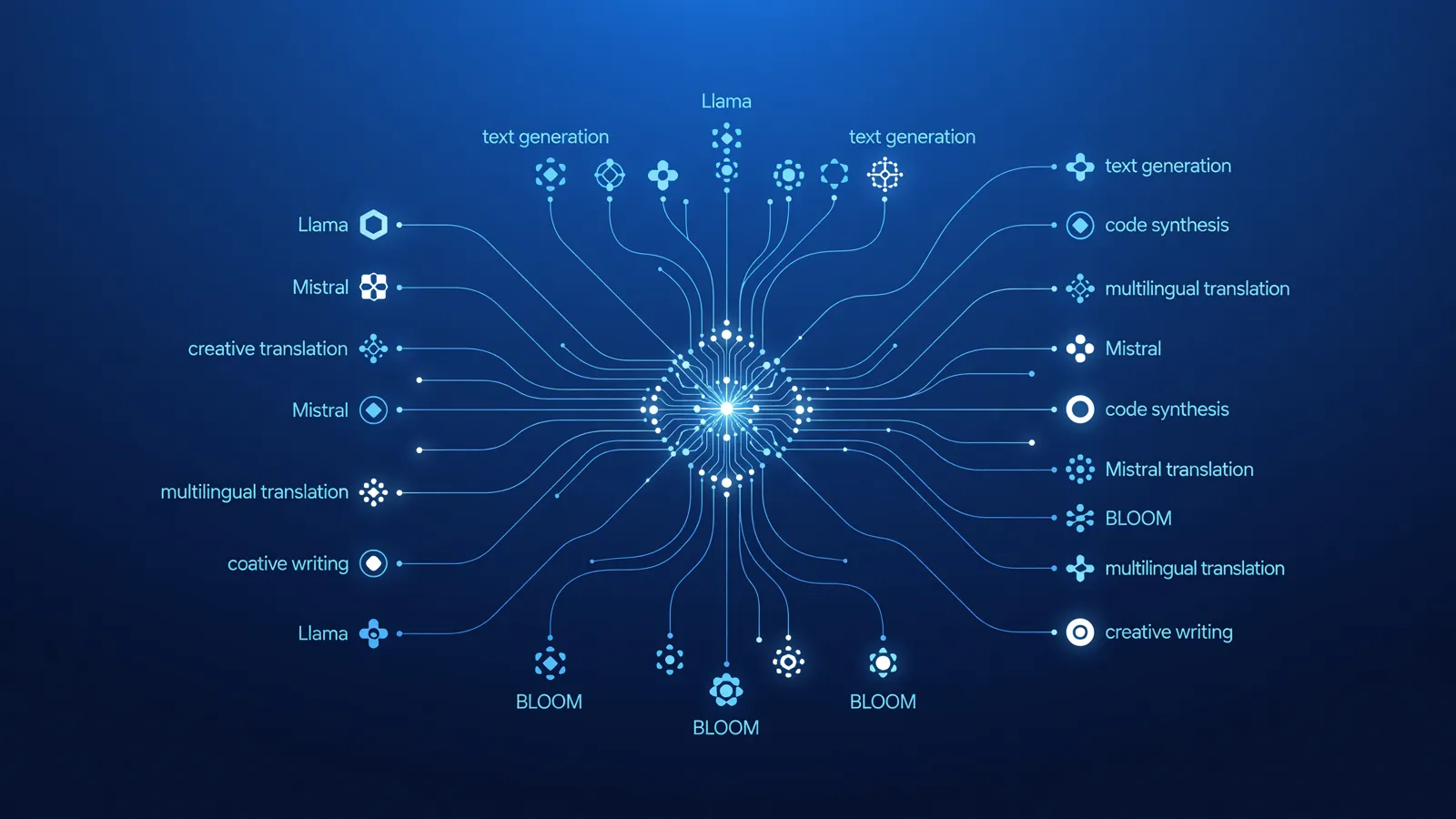
Meta Llama 3
License: Llama 3 Community License
Llama, developed by Meta, is the undisputed pioneer among powerful open-weights models. The third generation (Llama 3) offers models ranging from 8B to 70B (with 400B in development) parameters.
- Strengths: Exceptionally good at logical reasoning, broad general knowledge level, and excellent community documentation.
- Ideal for: General chatbots, complex RAG (Retrieval-Augmented Generation) pipelines, and code generation.
Mistral & Mixtral (Mistral AI)
License: Apache 2.0 (mostly)
The European startup Mistral AI surprised the market with highly efficient models. Their 'Mixtral' models utilize a Sparse Mixture of Experts (MoE) architecture, which ensures high performance with relatively low computing power requirements during inference.
- Strengths: Highly efficient memory usage (MoE), native support for long context windows (up to 32k or more), and an open Apache 2.0 license on their base models.
- Ideal for: Processing long documents, serverless inference, and commercial applications where a free license is crucial.
Qwen 2 (Alibaba Cloud)
License: Apache 2.0 / Qwen License
The Qwen model family performs remarkably well across a wide range of sizes (from 0.5B to 72B). Qwen 2 has made significant strides in mathematical capabilities and multilingualism.
- Strengths: Superior support for multiple languages (including European and Asian languages), coding, and mathematical problem-solving.
- Ideal for: Multilingual applications and analytical agent systems.
Gemma 2 (Google)
License: Gemma License (Permitted for commercial use)
Gemma is built on the same technology and research as Google's Gemini models. Gemma 2 (available in sizes such as 9B and 27B) excels in its weight class and offers robust performance on standard consumer hardware.
- Strengths: High efficiency-to-size ratio, strong focus on safety (safe-by-design), and seamless integration with Google Cloud, Kaggle, and Hugging Face.
- Ideal for: Local deployments, research, and development on standard GPUs.